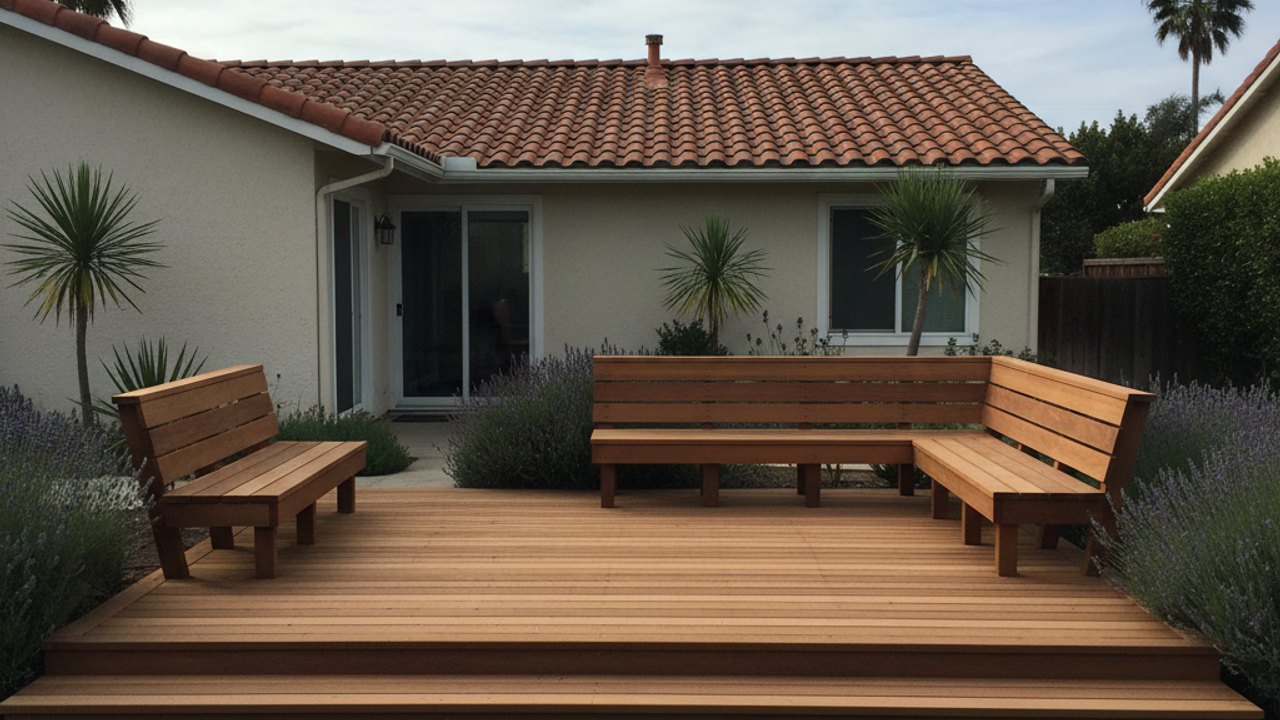
People ask us this a lot, usually in July when it's 102 degrees and they're standing on a deck that's falling apart. The honest answer is it depends what you're doing to the deck. Footings want different weather than stain does, and stain wants different weather than a composite installation. There isn't one golden month. There's a window for each job.
El Dorado Hills sits a little under a thousand feet up in the foothills, which means we don't get the deep frost that would mess with a Tahoe build, but we get hard swings between a dry 100-degree August and a wet 45-degree January. That swing drives most of the scheduling.
What the ground is doing matters more than the calendar
A lot of lots here sit on decomposed granite with pockets of red clay, especially around the older sections near Serrano and toward Cameron Park. Decomposed granite drains fast and compacts well, which is good for footings. Clay is the opposite. It swells when it's wet and shrinks hard when it dries, and if a footing goes in during a wet stretch on clay-heavy ground, you can get movement later as the soil dries out and pulls away from the concrete. We'd rather dig footings in the dry season, April through October, when the soil is stable and we're not fighting mud or slumping sidewalls in the hole.
Concrete itself also needs the temperature cooperating. Footings cure slowest and weakest below 40 degrees, which rules out the coldest nights of December and January unless we're using an accelerant, and they can flash-cure too fast in August heat if we don't manage the pour and keep it damp the first few days. Spring and fall give you the best cure without extra babysitting.
Heat changes how stain, sealant and composite behave
Staining a deck in the middle of summer here sounds logical because it's dry, but 100-degree board temperature makes stain and sealant flash off too fast. It skins over before it soaks in, and you end up with a blotchy finish that looks fine for a season and then peels. Late spring, roughly April into early June, and again in September and October, gives you warm dry days without the board surface cooking. That's really the sweet spot for staining and sealing, not July or August.
Composite decking has its own quirk. The boards expand and contract with temperature more than wood does. If you install composite boards tight together on a 100-degree day, they can shrink down and open gaps of a quarter inch or more once the weather cools. We leave gap spacing based on the installation temperature, which is a detail that matters more here than in a mild coastal climate because our daily swing in summer can be 40 degrees between a 3am low and a 2pm high.
Wildfire season shapes material choices, not just timing
El Dorado Hills is wildland-urban interface in a lot of neighborhoods, and defensible space rules matter if a deck attaches to the house within the first five feet. That pushes some homeowners toward composite or ignition-resistant materials rather than untreated wood, and it's a conversation worth having before you pick a product, not after it's installed. It doesn't really dictate when you build, but if you're demoing an old wood deck during fire season, June through October, we're careful about debris and dust, and some days with a red flag warning we won't run certain equipment at all.
Permits, HOAs and the paperwork calendar
Most deck work here that changes the footprint or the structure needs a building permit through El Dorado County, and if the deck attaches to the house or involves a change in height, expect an inspection of the footings before they're covered and a final inspection once railings and stairs are in. A lot of El Dorado Hills neighborhoods, Serrano, Blackstone, Heritage, Marble Valley, have an HOA with its own design review on top of the county process. That review can add two to six weeks depending on the HOA's meeting schedule, and some only meet monthly. If you want a deck finished before a summer you're already planning around, start the HOA submission in late winter. Waiting until May to submit plans for a July deck is the single most common reason people end up disappointed with their own planning, not with the contractor.
Rain season isn't dead time, it's repair season
November through March is our wet stretch, and it's a bad window for new footings or fresh stain, but it's actually a decent time to catch problems before they get worse. Rot shows up first where water sits, around post bases, under rail baluster connections, and at the ledger board where the deck meets the house. If flashing behind that ledger has failed, winter rain is what finds it, usually as a dark stain or soft spot on the siding above the deck. Catching that in January means a repair. Ignoring it until a dry August inspection sometimes means replacing a ledger board and the framing it's rotted into.
So the short version: dig and pour in the dry months, stain in the shoulder seasons when it's warm but not scorching, plan composite gap spacing around the day's temperature, and use the rainy months to find out what's already going wrong rather than waiting for a hot day to notice. If you want a second opinion on timing for your specific lot and slope, that's the kind of thing Alpha Deck Co walks through with people before anything gets scheduled.